
Two thousand years of “prevention is better than cure”
I love working in public health, but I do occasionally find myself cycling between periods of real passion and periods of helplessness. Sometimes within a single meeting…
Prevention is one of the topics that flips me between Enthusiastic Andy and Grumpy Andy, particularly the mismatch between decades of “prevention is better than cure” rhetoric and how little it sometimes seems to translate into meaningful action. But it got me thinking: just how long have we been saying this?
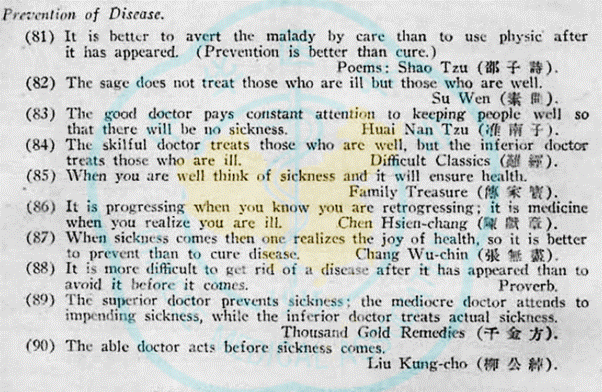
Turns out, it’s a long time. As is often the case, some of the earliest examples come from China. One of the best known is “the superior doctor prevents sickness; the mediocre doctor attends to impending sickness; the inferior doctor treats actual sickness”. The quote is sometimes attributed to the Huangdi Neijing, a foundational Chinese medical text compiled sometime between the 4th century BCE and 3rd century AD, but is more often considered simply an ancient proverb. In his 1926 collection of papers for the Chinese Medical Journal on Chinese medical sayings and proverbs, K. Chimin Wong attributed the quote to another text, Sun Simiao’s Beiji qianjin yaofang (“Essential Formulas Worth a Thousand in Gold for Emergencies”) published in 652. Either way, it’s old. Wong collates various other sayings on preventative medicine (see below), but elsewhere also on diet, exercise and moderation.
In the 1550s we get to Erasmus’ Adagia and his “prevention is better than cure”, the first verifiable articulation of the phrase. A couple of hundred years later Benjamin Franklin basically nicked his quote and flowered it up a bit, writing in the Pennsylvania Gazette in 1736 that “an ounce of prevention is worth a pound of cure”. Franklin wrote it about fire safety but, like a fire, his metaphor spread, into medicine, policy and public health.
In his 1732 Gnomologia: Adagies and Proverbs; wise sentences and witty sayings, ancient and modern, foreign and British, Thomas Fuller riffed on the ancient Chinese proverb above with his own version: “He who cures a disease may be the skillfullest, but he that prevents it is the safest physician”. Again, it’s a message about wisdom being found in prevention, not just technical expertise.
James Lind recognised that no treatment can undo unhealthy living conditions in his 1772 Essay on the Means of Preserving the Health of Seamen: “What medicine can counteract the continued influence of improper diet, air and confinement?”. Though he was specifically addressing the health and conditions of sailors, this could be considered one of the first articulations of what we now often call the social determinants or building blocks of health.
Rudolf Virchow built on this when, in investigating a typhus outbreak in 1848, he noted that you cannot treat yourself out of poverty, inequality and political exclusion: “Medicine is a social science, and politics is nothing but medicine on a larger scale.”
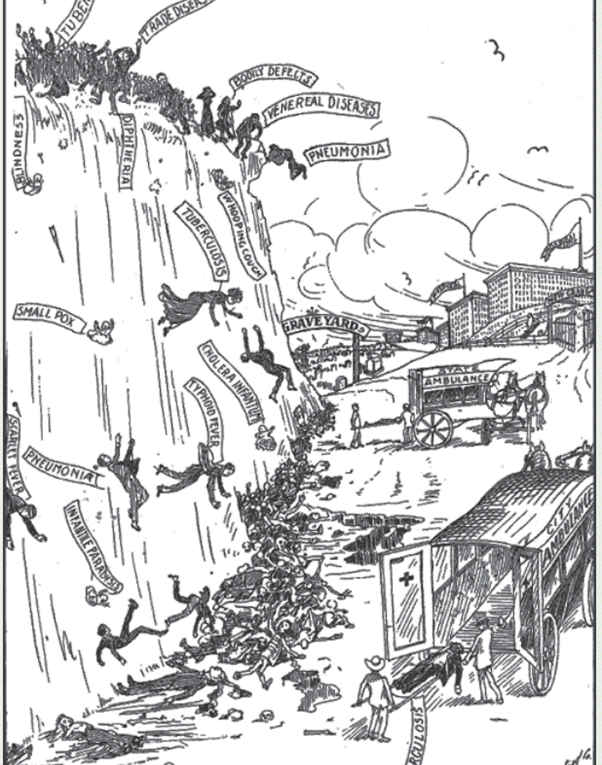
One of my favourite pieces on prevention and the folly of treating symptoms rather than causes is Joseph Malins’ 1895 poem, A Fence or an Ambulance. Coming across this poem a few years ago kicked off one of my “bloody hell, we’ve been saying this for ages” moments of doubt… It’s so good that I reproduce it here in full:
'Twas a dangerous cliff, as they freely confessed,
Though to walk near its crest was so pleasant;
But over its terrible edge there had slipped
A duke and full many a peasant.

So the people said something would have to be done,
But their projects did not at all tally;
Some said, "Put a fence ’round the edge of the cliff,"
Some, "An ambulance down in the valley."

But the cry for the ambulance carried the day,
For it spread through the neighbouring city;
A fence may be useful or not, it is true,
But each heart became full of pity

For those who slipped over the dangerous cliff;
And the dwellers in highway and alley
Gave pounds and gave pence, not to put up a fence,
But an ambulance down in the valley.

"For the cliff is all right, if you’re careful," they said,
"And, if folks even slip and are dropping,
It isn’t the slipping that hurts them so much
As the shock down below when they’re stopping."

So day after day, as these mishaps occurred,
Quick forth would those rescuers sally
To pick up the victims who fell off the cliff,
With their ambulance down in the valley.

Then an old sage remarked: "It’s a marvel to me
That people give far more attention
To repairing results than to stopping the cause,
When they’d much better aim at prevention.

Let us stop at its source all this mischief," cried he,
"Come, neighbors and friends, let us rally;
If the cliff we will fence, we might almost dispense
With the ambulance down in the valley."

"Oh he’s a fanatic," the others rejoined,
"Dispense with the ambulance? Never!
He’d dispense with all charities, too, if he could;
No! No! We’ll support them forever.

Aren’t we picking up folks just as fast as they fall?
And shall this man dictate to us? Shall he?
Why should people of sense stop to put up a fence,
While the ambulance works in the valley?"

But the sensible few, who are practical too,
Will not bear with such nonsense much longer;
They believe that prevention is better than cure,
And their party will soon be the stronger.

Encourage them then, with your purse, voice, and pen,
And while other philanthropists dally,
They will scorn all pretence, and put up a stout fence
On the cliff that hangs over the valley.

Better guide well the young than reclaim them when old,
For the voice of true wisdom is calling.
"To rescue the fallen is good, but ’tis best
To prevent other people from falling."

Better close up the source of temptation and crime
Than deliver from dungeon or galley;
Better put a strong fence ’round the top of the cliff
Than an ambulance down in the valley.
Next, we have another literary one, on the prevention of crime rather than poor health, in Arthur Conan Doyle’s 1915 The Valley of Fear. Here, my fictional hero Sherlock Holmes espouses about “that highest value which anticipates and prevents rather than avenges crime”.
In the 1970s we come to a retelling of Malins’ fable and a popular parable generally credited to the medical sociologist Irving Zola. The story describes a rescuer pulling drowning people from a river until they finally ask why no one is going upstream to stop people falling in. John B. McKinlay used the metaphor in his 1975 article A Case For Refocusing Upstream: The Political Economy Of Illness, arguing that our task is “constructing fences upstream and restraining those who […] continue to push people in.”
In modern times, Professor Sir Michael Marmot summed it up perfectly in his 2015 book The Health Gap: “What good does it do to treat people and send them back to the conditions that made them sick?”
Of course we also have various timeless proverbs showing that centuries of ordinary folk have understood that which systems struggle to implement: “a stitch in time saves nine”, “forewarned is forearmed”, “better safe than sorry.”
Alongside all these variations on ‘prevention is better than cure’, we also have a long history of sayings acknowledging that health is about more than healthcare, that the conditions shaping our lives matter more than what happens in the NHS (or in the barber surgeon’s or apothecary’s…).
Cicero’s “Salus populi suprema lex esto” – usually translated as some variation on “the health of the people is the highest law” – comes from his De Legibus, published sometime between 58 BC and 48 BC. A bit of a public health and local government favourite this one, it has been adopted into the mottos and/or coats of arms of a number of municipalities. In the UK, the best known example is probably that on Walworth Town Hall, installed by the then-Southwark Borough Council for the opening of the Walworth Clinic in 1937.

In 1948, the World Health Organization famously defined health as “a state of complete physical, mental and social well-being and not merely the absence of disease or infirmity.”
In that same year, John Ryle, the UK’s first Professor of Social Medicine (one of the many names by which what we now call public health has been known) further recognised health not just as the absence of disease but “the whole economic, nutritional, occupational, educational and psychological opportunity or experience of the individual or community.” I particularly like this definition.
So why does prevention still feel so difficult? If people across continents and centuries have all said versions of the same thing, why do systems still invest so heavily in the ambulance at the bottom of the cliff?
Partly it’s because treatment is visible and prevention is quiet; partly because benefits accrue slowly while political and organisational cycles move quickly; and partly because creating the conditions for health requires collective responsibility, not just individual action.
I’m currently in one of my optimistic moods, hoping and believing that we will collectively get there in prioritising the creation of the conditions necessary for good health, rather than only treating the symptoms. But I’m always aware of a favourite German word: Verschlimmbesserung – an attempted improvement that ends up making things worse. Prevention, or health creation, must be done properly, with care. Let’s build that fence.
—
As ever, agree or disagree, you can let me know on Twitter or LinkedIn. And please do let me know of any good examples I’ve missed!